
Still Washing in the Katonga
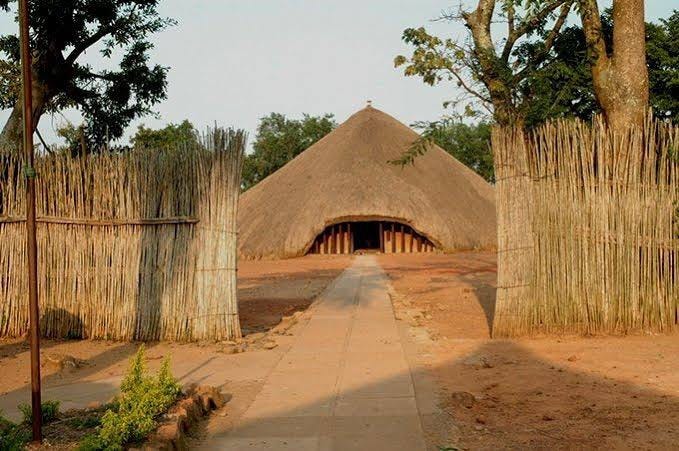
Bigo bya Mugenyi, the largest pre-colonial earthwork in sub-Saharan Africa, and this season's Sacred Site

Before anyone reaches the earthworks at Bigo bya Mugenyi, they stop at the river.
A guide leads the way through Kabeho, past old spears once carried by the people who kept watch here, and down to where the Katonga runs alongside a smaller river called the Kachinga. Visitors wash there. Not a symbolic gesture, an actual practice, hands and faces and feet in real water, before anyone is allowed to climb the hill toward the earthworks themselves. The water comes first because the people who still tend this place believe you don’t approach something sacred carrying whatever you walked in with.
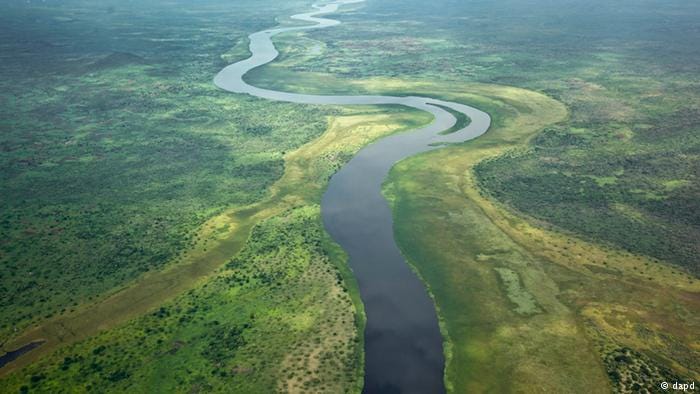
I learned about this place while researching Cancer season, looking for somewhere that could hold the way water, protection, and inheritance get built into stone and earth. What I found instead was something better than a parallel. Bigo is the largest ancient earthwork ever recorded anywhere in sub-Saharan Africa, a system of ditches and embankments running more than ten kilometers, and almost nobody outside Uganda has heard of it.
That alone would be reason enough to write about it. But the deeper I read, the more this site kept doing something I didn’t expect from a piece of research. It kept correcting me.
What the Word Fort Actually Hides
Locally, the site is called Bigo bya Mugyenyi, the fort of the stranger. For most of the last century, that name got taken at face value by everyone studying it from the outside. A British colonial officer named D.L. Baines documented the earthworks in 1909 and called them defensive. Major C.R. Hall mapped them the same way in the years after. The Uganda Protectorate’s geological survey repeated the assumption again in 1921. When archaeologists finally got their hands dirty at the site, P.L. Shinnie in 1957 and then Merrick Posnansky in 1960, spending seven weeks excavating more than twenty trenches and recovering over four thousand pottery sherds, they were still working from the same starting point Baines had set half a century earlier. This was a fort. Forts get built by people preparing for war.
It took later archaeological review, working back through that same physical evidence with fresh eyes, to ask a better question. Not who was Bigo defending against. What was Bigo actually feeding.
The faunal remains pulled from Posnansky’s trenches are dominated by cattle bone. The material culture points toward a pastoral economy, not a garrison. And the outer ditch itself gives away the real story if you look at where it goes. A defensive wall wants a clean perimeter, a hard line between safety and danger. Bigo’s outer ditch does the opposite. It branches. It opens in multiple places. Long sections of it run straight into the Katonga River, as though the river was always meant to be part of the boundary rather than a threat sitting outside it.
That’s the signature of something built to manage where a herd could move and where it could cross water, not something built to keep an army out. Cattle, in the world that raised these earthworks, weren’t decoration on a kingdom’s wealth. They were the wealth itself, the means by which a family married its children, settled its debts, and got through a bad season. An elaborate system engineered around where animals could safely drink and graze isn’t a war story. It’s a mothering story, built at the scale of an entire kingdom.
Sixty Years Is a Long Time to Carry the Wrong Word
It’s worth sitting with how long the fortress reading actually held, because the people repeating it weren’t careless. Shinnie was a trained archaeologist. Posnansky spent weeks in the dirt doing exactly the kind of patient, careful documentation good fieldwork requires. Neither man invented the fortress story out of nowhere. They inherited it, the way most people inherit the frame they were handed before they ever picked up a trowel.
Part of where that frame came from is easy to trace. Oral tradition collected during the colonial period, filtered already through colonial assumptions, claimed the Bachwezi and the dynasty that followed them had invaded the region from the north. Officers who’d just lived through the Bunyoro-Buganda conflicts of the 1800s, who’d built their own forts elsewhere in western Uganda, who in some cases had served in the trenches of the First World War, looked at a massive ditch system and an invasion story and didn’t need much convincing. The two fit the only template they already carried for what large earthworks in Africa were supposed to mean.
So the empire that misread Bigo wasn’t reading the ground in front of it. It was reading its own recent history and projecting that history backward four hundred years, onto people who’d never given anyone a reason to think they’d built this place for war.
A People Remembered More for Mercy Than Might
The Bachwezi sit in an unusual space between archaeology and legend, and the honest version of this story holds both at once rather than resolving the tension too neatly.
The historian D.W. Cohen wrote about the Cwezi cult in 1968, and J.P. Chrétien followed in 1985 with a study whose title says the quiet part directly, the construction of a geopolitical imaginary. Both scholars treat the idea of one unified Bachwezi empire with real caution. The documented royal line runs to only two or three names. The reign is remembered as brief. Parts of the oral record carry visible fingerprints of later colonial-era reshaping, the same invasion narrative that helped manufacture the “fortress” understanding in the first place.
But here’s where the story turns somewhere Cahokia and most sites in this series can’t reach. The political history may be uncertain. The spiritual one never stopped.
Chwezi spirit-possession survived the dynasty, (if the dynasty existed in quite the shape oral tradition describes at all). It became, and remains, a living practice, documented under different names across the Nyoro musegu, the Rundi ikishegu, the Ha and Ankole imandwa, the Luba mbudye, and the Sukuma and Nyamwezi swezi traditions of Tanzania. Researchers working in Tanzania have found active Chwezi initiation happening quietly today, the initiated keeping their identity to themselves rather than displaying it.
And near Bigo itself, local guides tell a smaller, gentler version of why this particular site is the one people still remember out of several similar forts in the region. Two nearby sites, Ndawula and Nakayima, were once just as significant. Bigo kept its visitors because, as one local guide put it, the site was nearer and had mercy on people. Not because it was stronger. Because it was kinder. That’s not a detail you find in a colonial survey. It’s the kind of thing that only gets passed down by people who’ve kept coming back.
Ahead of the List, Not Behind It
Bigo bya Mugenyi was added to Uganda’s tentative list for UNESCO World Heritage status on September 10, 1997. Tentative isn’t inscribed. The site is recognized as a serious candidate, formally on record, still waiting on the fuller nomination and review process that would bring full World Heritage status.
That waiting doesn’t need an apology attached to it. Bigo was already the largest known ancient monument in Uganda long before any UNESCO list existed, long before the British empire that first misread it had even finished doing so. A tentative listing just means international recognition is catching up to something the earthworks, the cattle bone, the pottery, and six centuries of continuous Chwezi practice never needed anyone’s permission to already be true.
Working With Bigo This Cancer Season
Cancer season runs from June 21 through July 22, and the Moon, which rules the sign, knows the difference between a structure built to keep an enemy out and a structure built to hold what actually feeds a household.
Bigo asks that exact question of anyone willing to sit with it. What gets mistaken for defensive that was really built for care? Picture the herders moving cattle through those branching openings toward water, the same ditches that got called a war wall for sixty years, actually shaped around feeding and protecting and provisioning a people, season after season, the unglamorous daily work no colonial survey thought to ask about.
The New Moon in Cancer on July 14 is a fitting moment to look for that same misreading somewhere closer to home. Something in your own life that looks guarded from the outside might be structured around care the whole way through. Worth asking before assuming you already know which one you’re looking at.
Cancer Season Independence Dates: Somalia (July 1, 1960) · Burundi (July 1, 1962) · Algeria (July 5, 1962) · Venezuela (July 5, 1811) · Colombia (July 20, 1810)
This is a Counter-Cartographic piece for Wayfinder’s Field Notes, part of an ongoing practice of returning to maps, monuments, and earthworks that colonial translations got wrong, and asking what they were actually built to do. So far we’ve explored Chichen Itza, Cahokia Mounds, and Angkor Wat. Consider giving them a gander!
Saki Savavi is a Liberation Cartographer and Interdisciplinary Artist. She is the author of the Leyline Almanac and the publisher of Wayfinder’s Field Notes.
Browse historical and counter-cartographic maps at Tarru Nadi on Etsy. Book a 1:1 session at Compass Collective.
“Sub-Saharan” is a colonial language classifying us as “sub-humans” thank you for feature
Love the work you do !! Whoop whoop 🙌